
When we asked 100 athletes in Poland, Türkiye, Belgium and Norway how confident they feel in six areas that matter for running a business, the answers showed a clear pattern of strengths and gaps.
| Area | Average confidence, out of 5 |
|---|---|
| Teamwork and leadership | 4.6 |
| Resilience and mindset | 4.4 |
| Public speaking | 3.8 |
| Digital marketing | 3.2 |
| Financial planning | 2.3 |
| Legal and regulatory knowledge | 1.9 |
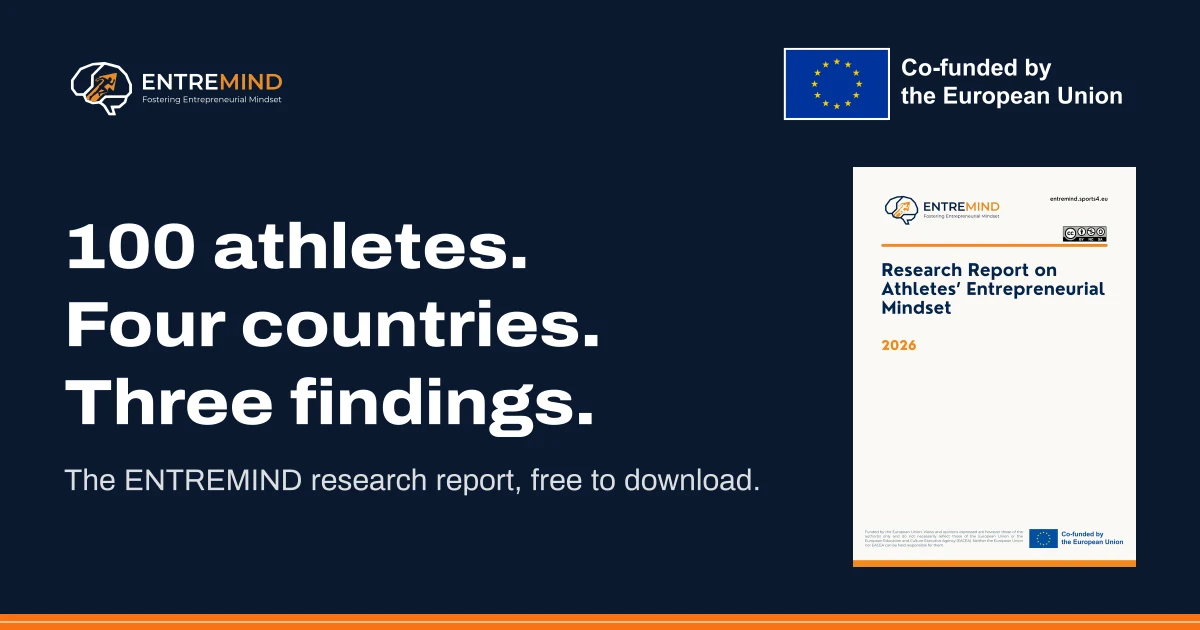
These numbers come from the survey in our research report. They say more about what athletes need than any motivational poster.
The top of the table came from sport
The two highest scores are exactly what sport builds. The report reads teamwork and leadership as a strong asset carried over from sport. Resilience is built through losses, injuries and being left out of the team, and then coming back. Public speaking sits in the middle, and the report links that to the media experience many athletes already have.
The bottom of the table is method, not character
The report calls financial planning and legal knowledge a critical gap in all four countries. Neither is a personality trait. Both can be learned, and the athletes in the study know where their gap is.
The research report puts it bluntly. Athletes have had plenty of mentoring on motivation, but they remain under-skilled in the practical side of running a business. What they need is not another talk about believing in themselves, but spreadsheet templates, tax calculators and contract checklists.
That is the gap between knowing and doing. Across the four countries, athletes rate their interest in starting a business at 3.9 out of 5 on average. The will is there. The method is what is missing.
Where to start closing the gap
A practical gap needs practical answers. The training kit has a few good starting points:
- Paperwork first, if you plan to register a business. The kit lists an official starting point in each partner country: Akademia PARP in Poland, KOSGEB’s entrepreneurship training in Türkiye, the Norwegian Tax Administration’s courses for new businesses together with Altinn’s start-up guide in Norway, and, for Brussels only, hub.brussels with its advisers and workshops.
- Money next. The kit points to Wharton’s course on financing and profitability, on Coursera, as the single most useful piece for an athlete planning around a limited earning window. It is part of a paid series; check whether the course offers free access before you enrol, and apply for financial aid if cost is a barrier.
- One book. Profit First is on the kit’s short list for a simple reason: revenue is not profit, and athletes routinely confuse the two.
For the empowerment toolkit, which is being built now, the report recommends a module on the money basics, one of the two biggest gaps in the survey.
Check your own numbers
The same six areas are in the assessment tool. It takes fifteen to twenty minutes, and you can set your own answers against the table above to see which gap to close first.
ENTREMIND is an Erasmus+ Sport partnership co-funded by the European Union (project 101229842).