“I’m making some money selling sneakers on the side, but it’s not official or anything. I’m honestly afraid to register a company because the taxes are so high, and the rules seem to change all the time.”
A basketball player in Türkiye told us this in an interview for our research report. It is a familiar story, above all in Türkiye. Some athletes already run a small business: they coach, sell things, create content or make paid appearances. They just do it without registering.
Why it stays off the books
The reasons are easy to understand. The rules look complicated, they seem to change often, and registering feels expensive. In our study this pattern was strongest in Türkiye, where economic instability also pushes athletes to earn now rather than later. Another basketball player there, answering our survey, put the real problem in one line: “I don’t know how to formalize what I’m doing.”
What staying informal costs
An informal business can make money, but it cannot grow very far. Without registration there are no loans, no legal partnerships and no legal protection if something goes wrong. The report calls avoiding registration a rational calculation, but one that limits how far the business can grow.
The first step, country by country
Our training kit has a learning route for exactly this situation, called Side-Hustler. Its first step is the one athletes most often skip, and the one that matters most: the official course on registration and tax in your own country.
- Türkiye: KOSGEB’s entrepreneurship training, free and online, with the application made through e-Devlet. Its certificate is the gate to KOSGEB’s support programmes. Plan it as an off-season project, because it runs to roughly 50 to 70 hours, and check first that your type of activity qualifies for support.
- Poland: the free course “How to start your own company” on Akademia PARP, the learning platform of the Polish Agency for Enterprise Development.
- Norway: the Norwegian Tax Administration’s free courses for new businesses, also available in English, and Altinn’s guide to starting and running a business, which comes with a free advisory phone line.
- Belgium: in Brussels, hub.brussels and its 1819 information service, with advisers and workshops in English, French and Dutch.
The route then goes further: turn the audience you already have into customers with a course on digital marketing, and check whether the activity actually makes money. In the kit’s words, the aim is to be able to say whether your side income is “a business or an expensive hobby”.
What comes next
For the empowerment toolkit, which is being built now, the research report recommends a module on the paperwork in each partner country. Until then, if you are unsure about your own situation, talk to an accountant or your local business advice service before you register. The rules depend on what you do and where you do it.
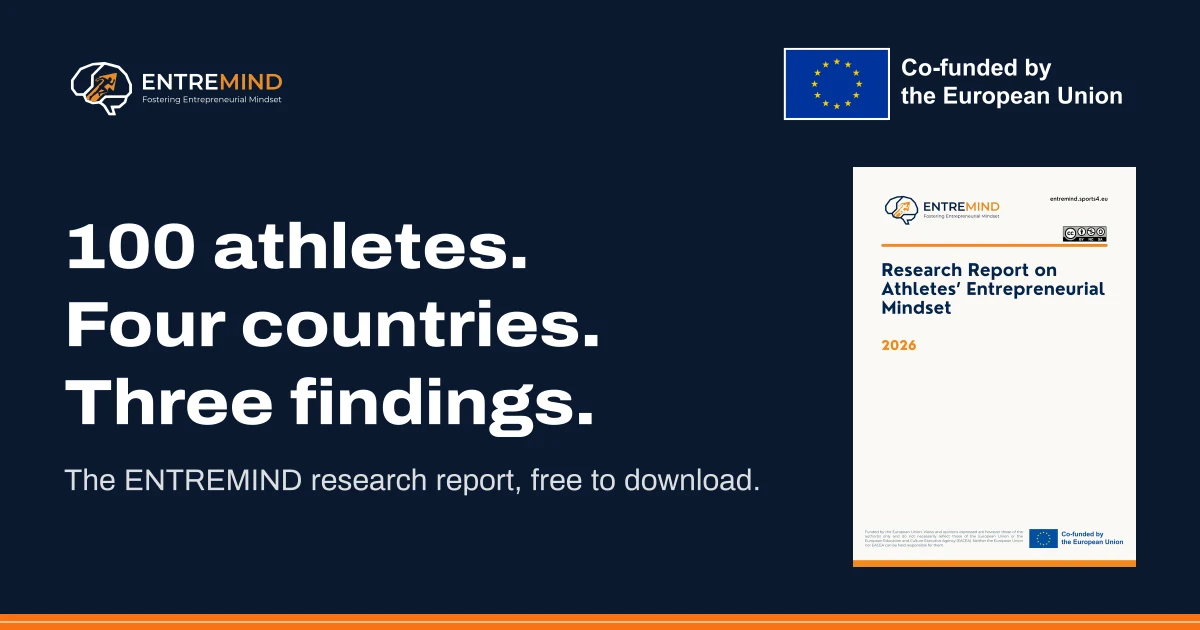
The research report has more on how athletes in each country see this barrier.
ENTREMIND is an Erasmus+ Sport partnership co-funded by the European Union (project 101229842).