
The ENTREMIND assessment tool was written for athletes, but it was also built for the people around them. Coaches and career advisers can use it to give a talk about life after sport some structure, and to see who needs more support. It also sets a baseline: when the athlete takes it again later, you can both see what has moved.
The tool ends with a short guide for exactly this. Here is what it recommends.
One to one or in a group
One to one. Give the athlete the assessment. It needs no facilitation. Offer a conversation afterwards, and leave the choice to them.
In a group. Book a quiet room and allow 25 to 30 minutes: 20 to fill it in, 10 for a general discussion. Individual results are never discussed in the group.
The questionnaire is printed and scored with the key, so bring enough copies. Before anyone starts, the guide suggests a short briefing:
“This helps you understand your entrepreneurial strengths and where the programme can support you. No right or wrong answers. Your results are confidential.”
It is a development tool, not an evaluation, and the briefing should make that clear.
Talking through the results
The guide describes the conversation in five steps.
- Normalise. Every athlete has strengths and areas to grow. That is the point of the exercise.
- Start with strengths. Begin with what scored well, and make clear that a career in sport has built something real.
- Walk through the 10 parts together. Athletes respond well to specific feedback: this part is a real asset, that one needs work.
- Turn each gap into a step. One concrete action, with a date.
- Watch the emotional response. Leaving sport can be deeply emotional. If you see distress, respond with empathy.
Profiles that need care
The guide flags some combinations that need extra care:
- A very strong athletic identity with very low self-efficacy. Work on identity first, and consider referring the athlete to a sport psychologist.
- A strong mindset held back by high barriers. The athlete has the mindset but feels blocked. Focus on removing the barriers.
- Low social capital in an athlete who has already retired. There is a risk of isolation. Connect them with networking events, a community and mentors.
If self-efficacy is very low across the board, explore it gently, one to one.
A simple plan
The guide also includes a planning template:
- the three strongest parts, and how to use them;
- the three parts to develop;
- whether one of the three groups of mindset parts is clearly weaker than the others;
- the athlete’s number one barrier, and one concrete step to reduce it;
- one action for the next 30 days;
- a review after 90 days, when the athlete takes the assessment again.
Ground rules
- The results belong to the athlete. Never share them without explicit consent. The athlete guide tells athletes the same: their individual responses are confidential.
- It is a development tool, not a clinical test. Never use it to label, diagnose or select anyone.
- Taking part is voluntary. An athlete can decline, or keep the results private.
- Leaving sport can bring up worry, grief or questions about identity. Respond with empathy and point to the right support.
- Entrepreneurship means different things in different cultures. Approach it with that in mind.
Pair it with the stories
Our training kit adds a second tool for the same conversation. Each of its 14 athlete stories ends with two reflection questions written for a one to one talk, and they also work as prompts for pairs in a workshop. After the assessment, the kit’s story index lets an athlete start with stories about the parts that came out red or amber.
The kit also gives one warning: do not use the stories in a group as motivation alone, without the reflection step. In its words, “inspiration without a next action tends to fade within a week.”
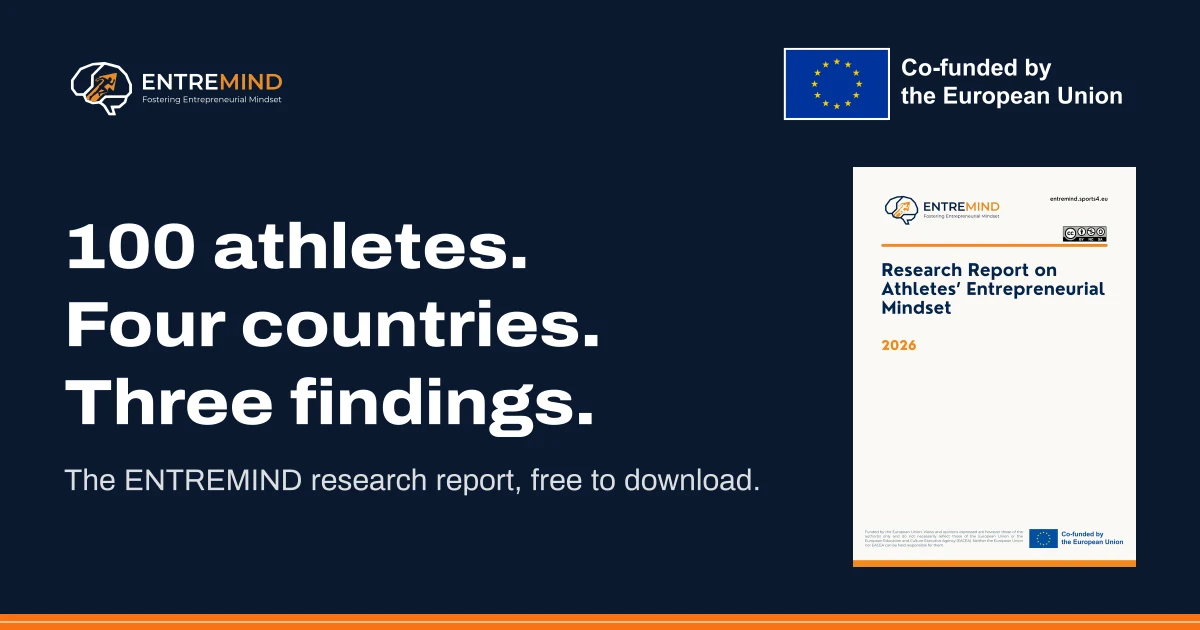
Both are free to download: the assessment tool and the training kit. For what the tool measures and how athletes read their results, see our introduction to the assessment tool.
ENTREMIND is an Erasmus+ Sport partnership co-funded by the European Union (project 101229842).